
Japanese Rice Fish (Medaka): Care, Breeding & Best Strains
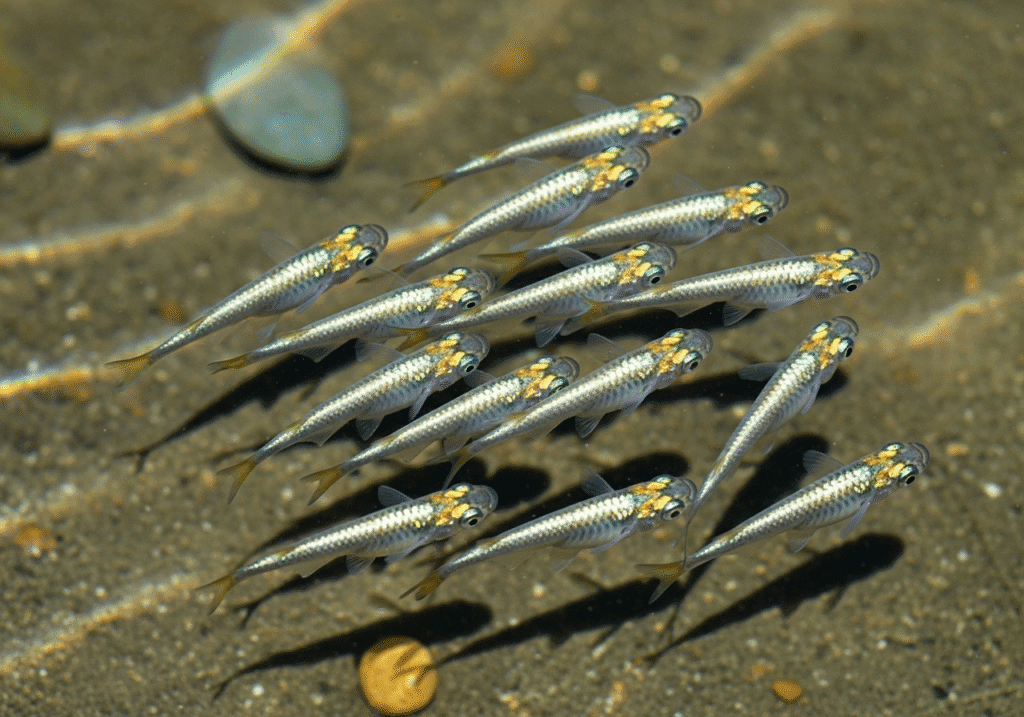
Table of Contents
- What Are Japanese Rice Fish (Medaka)?
- Why Medaka Are Exploding in Popularity
- Quick-Start Care & Setup
- Breeding Made Easy (Step-by-Step)
- Visual Sexing Guide (At-a-Glance)
- Strains You’ll See (Wild & Ornamental)
- Real-World Breeder Pricing (Global Snapshot)
- Where They’re Trending—and Why
- Community, Events & How to Source Great Fish
- FAQs (fast answers)
What Are Japanese Rice Fish (Medaka)?
Meet Oryzias latipes—better known as Japanese Rice Fish (Medaka)—a pocket-sized, peaceful fish cherished in Japan for centuries. They thrive without heaters, sparkle in sunlight, and breed like champs. Think of them as the “nano koi” of balcony bowls and patio ponds.
Why Medaka Are Exploding in Popularity
- Heater-free heroes: Comfortable from cool room temps to warm summers.
- Outdoor naturals: Perfect for patio tubs, balcony bowls, and mini ponds.
- Beginner-friendly breeders: Eggs almost daily in season; fry are straightforward.
- Collectible colors: Hundreds of strains—metallics, glitter (“lamé”), jet black, red cap, long-fin, short-body, and more.
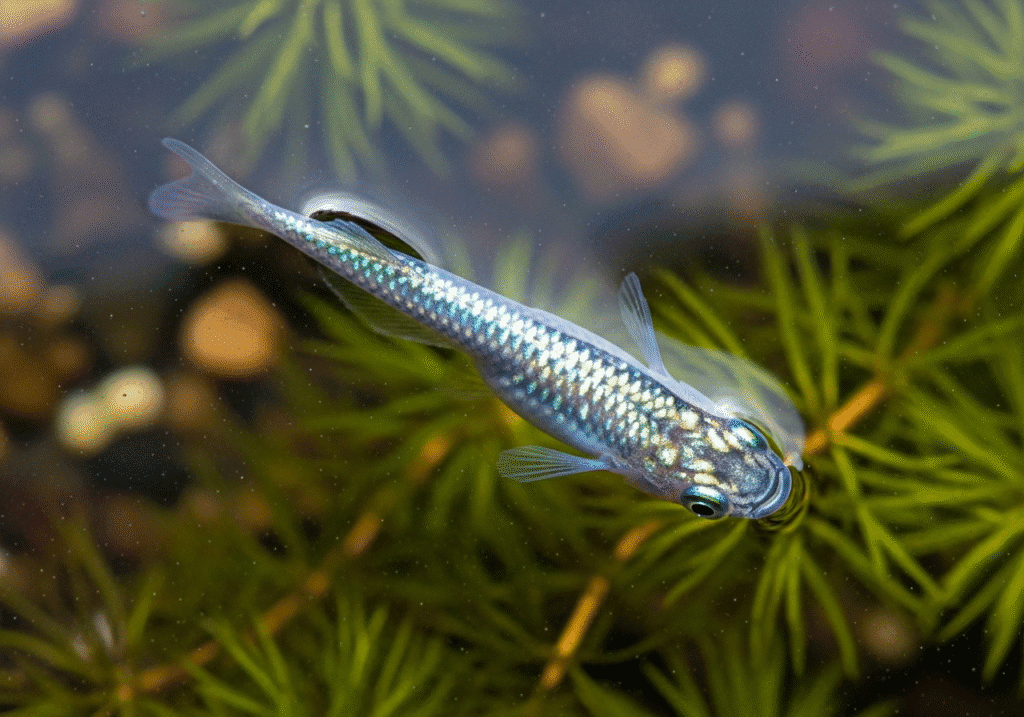
- Small space, big sparkle: Best viewed from above; they shimmer like living gemstones.
Quick-Start Care & Setup
Tank/Tub: 8–40 L (2–10 gal) for a group; bigger is better outdoors.
Water: pH 6.5–8.0; gentle filtration; regular small water changes.
Temp: Happy ~18–28 °C (64–82 °F). No heater needed in most homes.
Light: Natural daylight or gentle LEDs—great for color and breeding.
Décor: Floating plants, fine-leaf stems, or yarn mops for egg laying.
Diet: Quality micro-pellets/flakes; boost with baby brine shrimp, daphnia, microworms.
Tankmates: Peaceful nano fish and shrimp (note: eggs/fry may be snacked on).
Pro tip: Keep them in shallow, sun-kissed tubs outdoors during warm months; the top-down view is addictive.
Breeding Made Easy (Step-by-Step)
- Condition adults with rich foods for 1–2 weeks.
- Set the mood: 12–14 hours of light and temps ~24–27 °C (75–80 °F).
- Provide mops/plants: Females carry eggs briefly, then deposit on fine textures.
- Collect eggs daily: Move mops (or hand-pluck eggs) to a hatching container.
- Incubate ~4–10 days (faster when warmer).
- First foods for fry: Baby brine shrimp, green water, or powdered fry feed.
- Grow-out: Frequent tiny water changes and easy access to food = fast growth.
Common hiccups & fixes:
- Fungus on eggs? Remove opaque eggs; optional methylene blue in hatch tray.
- Adults eating fry? Separate eggs/fry or densify with plants.
- Seasonal slump? Add warmth/light; they’re long-day spawners.
Visual Sexing Guide (At-a-Glance)
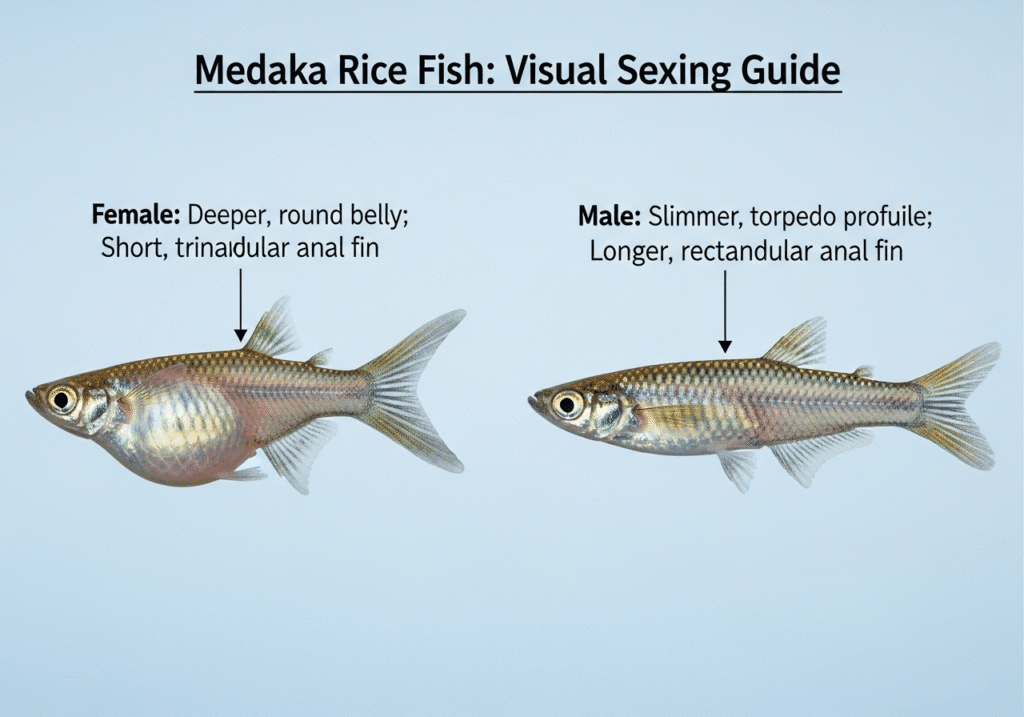
Body shape (side view):
- Female: Deeper, round belly—especially when egg-laden.
- Male: Slimmer, torpedo profile.
- Anal fin (the cheat code):
- Female: Short, triangular—widest at the base, pointed rear.
- Male: Longer, more rectangular/trapezoid.
Behavior:
- Males do the chasing/courting in the morning.
- Females sometimes seen carrying a pearl-like cluster of eggs before depositing.
Strains You’ll See (Wild & Ornamental)
Wild-type: Earthy olive/brown with silver belly—ancestral look, super hardy.
Himedaka (Orange): Classic bright orange; the “goldfish” of medaka.
Shiro (White/Platinum): Pearly white, luminous from above.
Miyuki (Sky Blue): Neon blue dorsal shimmer—stunning top-view in ponds.
Lamé (Glitter): “Star-dust” metallic flecks (e.g., Sapphire Lamé).
Orochi (Black): Velvet-black, dramatic contrast in green tubs.
Tancho (Red Cap): White body with a single red head spot—mini koi vibes.
Sanshoku/Calico: Tricolor patches; every fish is a surprise.
Daruma (Short-body): Cute, compact body; gentle flow preferred.
Long-fin: Flowing, butterfly-like fins; premium show strains.
Albino/Transparent: Pink-eyed or see-through educational curiosities.
Collector tip: Keep strains separate to preserve traits. Label tubs; log pairings.
Real-World Breeder Pricing (Global Snapshot)
Prices vary by strain quality, rarity, and local supply. Below are typical breeder (not chain-store) ranges to set expectations:
- Japan: Common lines often under $1–$5 each; special/brand-new lines $20–$200+ per fish; elite show stock can go far higher.
- USA: Common lines $5–$10 each; specialty lines $15–$50 each; rare pairs $100–$200; eggs for rare lines often sold in small batches.
- Europe: Common lines €4–€10 each; specialty €15–€30; egg batches for fancy strains commonly offered by breeders.
Money-saving move: Start with eggs or juveniles from reputable breeders; grow your own colony.
Where They’re Trending—and Why
- Japan: The cultural home; dedicated medaka shops and fairs.
- United States & Canada: Rapid growth via patio-pond and nano-tank trends; local fests and clubs emerging.
- Europe: Big with balcony-pond and plant-tank keepers; more EU breeders every season.
- SE/East Asia: Expanding farmed supply and export; thriving local scenes.
Drivers: heater-free keeping, easy breeding, outdoor suitability, and a never-ending stream of new colors.
Community, Events & How to Source Great Fish
Find your people:
- Reddit (r/medaka), Facebook medaka groups, Instagram #medaka / #メダカ.
- Local aquarium clubs; watch for “Medaka Fest”-style meetups.
- National associations (e.g., new medaka groups/associations) promoting ethics and lineage.
Buying checklist (copy/paste):
- Ask for the strain name and lineage (who bred it).
- Request current photos/video of actual stock.
- Clarify age/size (juveniles vs breeding adults).
- Confirm shipping method and DOA policy.
- For eggs: confirm fertility handling and hatch timing.
FAQ
How many Medaka should I start with?
A group of 6–10 is ideal for natural behavior and easy breeding.
Do they need a heater?
Usually no. Room-temp conditions are fine; they’re comfortable across a wide range.
Will they eat my shrimp?
Adults generally ignore adult shrimp; they’ll eat shrimp babies and medaka eggs if they find them.
How long do they live?
About 2–5 years; peak breeding is often in year 1–2.
How fast do fry grow?
With good food and clean water, juveniles sex out around 2–3 months.
Final Take
Japanese Rice Fish (Medaka) are the perfect mix of approachable care, dazzling variety, and breeding fun. Whether you keep a single sunlit bowl or a rainbow of labeled strains, they’re tiny fish with a giant fan club—for very good reason.
Checkout my story on successfully breeding Medaka.