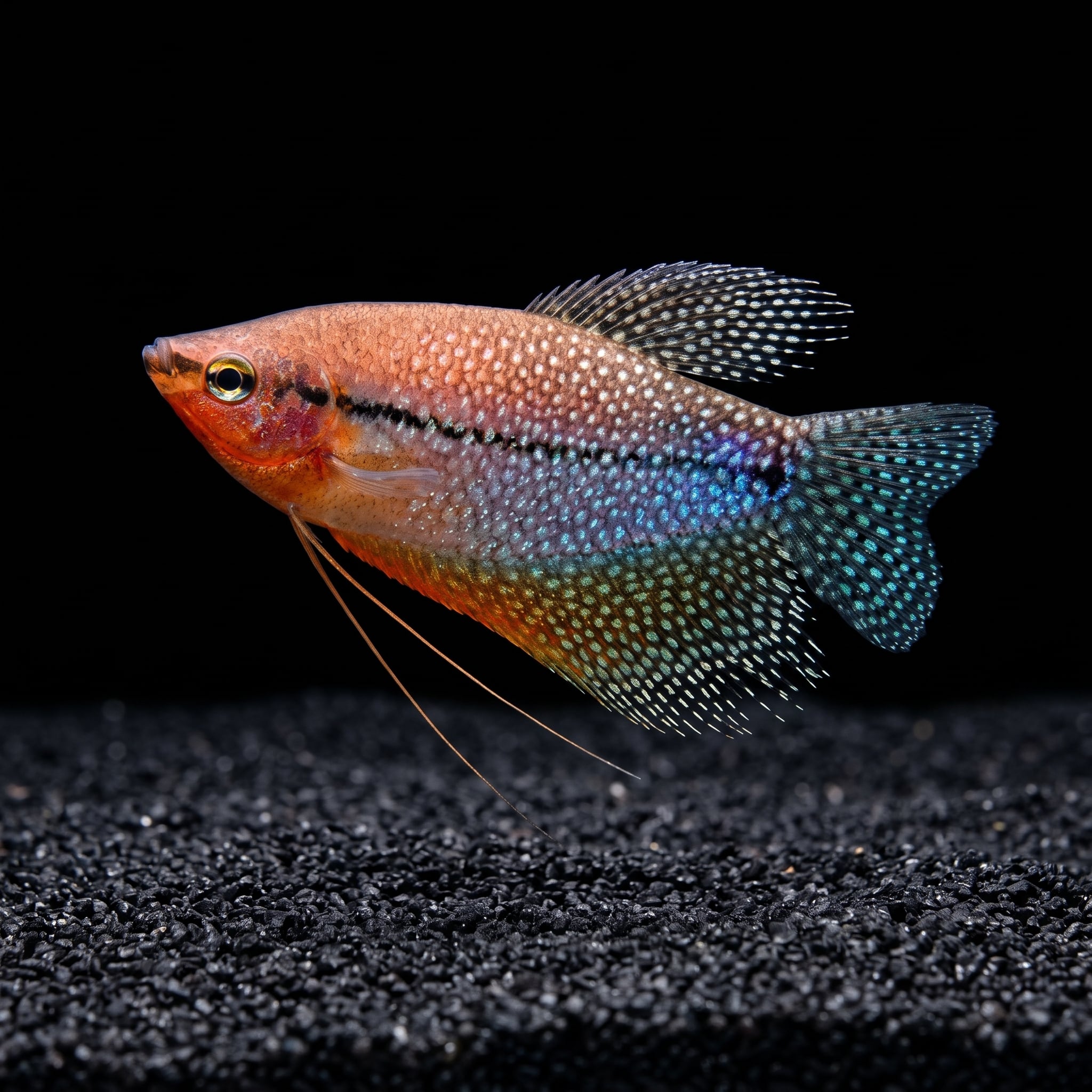

Quick Overview of the Pearl Gourami
The Pearl Gourami (Trichopodus leerii), also celebrated in the hobby as the Lace Gourami or Diamond Gourami, is native to the quiet, densely vegetated lowland swamps, peat marshes, and shallow rivers of Thailand, Malaysia, and Indonesia. Reaching an elegant adult size of 3.5 to 4.5 inches (9 to 11.5 cm), it offers the perfect balance of centerpiece presence without outgrowing standard community setups.
As visible in the image above, the Pearl Gourami is defined by its dense dusting of iridescent, pearl-white flecks that create an elaborate lace-like tapestry across its entire body and extended fins. A distinct, jagged dark lateral stripe runs from the snout across the eye to the tail base. Dominant males develop a glowing crimson-to-orange throat and breast, accompanied by sweeping, thread-like extensions on the anal fin. Equipped with sensitive, modified pelvic feelers, they gently touch and explore plant stems, hardscape, and tankmates as they navigate their surroundings.
Tank/Plant Profiles & Environmental Requirements
-
Care Level: Very Easy / Beginner Friendly
-
Growth Rate / Activity: Moderate Growth; Graceful, Calm Mid-to-Top Water Column Explorer
-
Lighting: Low to Moderate (Floating plants provide the dappled shading they prefer)
-
Temperature: 24°C – 28°C (Thrives naturally in Bacolod’s warm tropical room climate)
-
Tank Placement: Mid-to-Top Water Column Dwellers
-
Minimum Tank Size: 20–30 Gallons for a single specimen or bonded pair; 40–55+ Gallons for a small group or community display
Local Care Tips for Bacolod Aquarists
Bacolod Tap Water Match, Temperature & Gentle Flow: Pearl Gouramis are remarkably adaptable and thrive in Bacolod’s typical neutral-to-slightly-hard tap water (pH 6.8–7.8) when treated with a high-grade dechlorinator. Hailing from sluggish, swampy river margins, they require gentle water flow. Avoid harsh powerheads and turbulent wavemakers; use an adjustable hang-on-back filter, external canister with a spray bar directed toward the glass, or sponge filters. Adding local Talisay (Indian Almond) leaves releases mild humic acids and soft tannins, which condition their delicate slime coat, support immune resistance, and bring out rich orange hues on courting males.
Aquascaping Strategy, Floating Cover & The Epiphyte Rule: Pearl Gouramis are peaceful and naturally cautious, showing their brightest colors only when they feel secure under overhead cover. Maintain a generous surface mat of floating plants like Salvinia, Red Root Floaters, or Water Lettuce, which males also utilize to anchor their intricate bubble nests. Plant tall background stems (Vallisneria, Rotala, or Ludwigia) to break up lines of sight. Frame your hardscape with easy epiphytes like Anubias Barteri, Java Ferns, or Bucephalandra tied securely to driftwood or Seiryu stones—just remember the golden rule: the creeping rhizomes of these epiphytes must remain completely exposed above the substrate to keep them from rotting!
Dietary Specifics, Community Harmony & Labyrinth Care: Pearl Gouramis are unfussy omnivores. Feed a balanced daily diet of high-quality tropical flakes, slow-sinking micro-pellets, spirulina wafers, and regular treats of frozen bloodworms, brine shrimp, and daphnia. They are among the most peaceful gouramis in existence, pairing effortlessly with peaceful schooling tetras (like Cardinal, Costae, or Congo Tetras), Corydoras, Otocinclus, and Horned Nerite Snails. While they will ignore adult Neocaridina and Caridina shrimp, their inquisitive nature means they will graze on tiny newborn shrimplets, so ensure dense moss beds are present if breeding shrimp. A secure, tight-fitting aquarium lid is mandatory—not only to prevent unexpected leaps, but to ensure the pocket of air above the surface remains warm and humid, protecting their specialized labyrinth breathing organ from chill shock.