
Quick Overview of the Congo Tetra
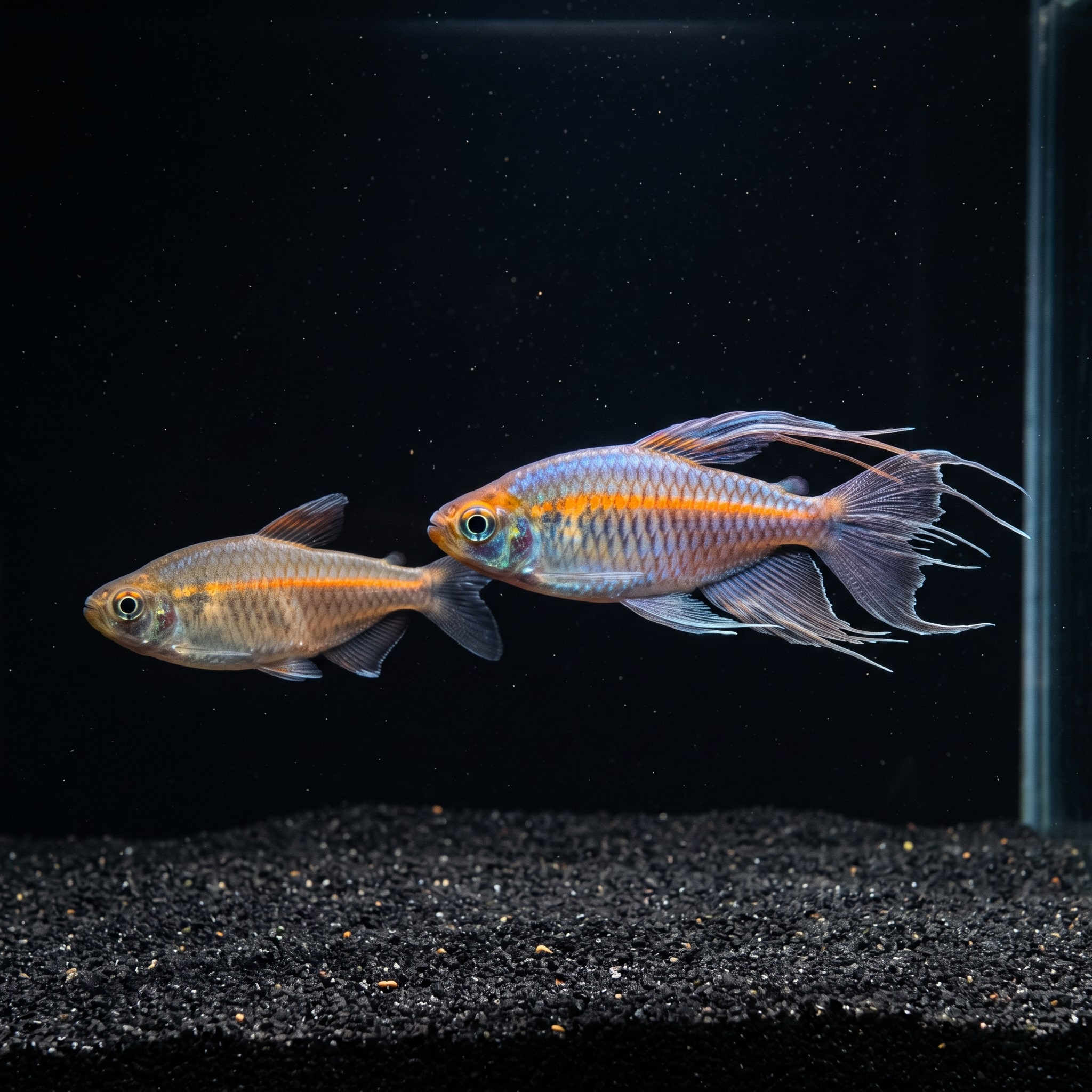
The Congo Tetra (Phenacogrammus interruptus) is widely regarded as one of the most stunning freshwater shoaling fish in the aquascaping hobby. Native to the clear, vegetated rivers and tributaries of the Central Congo River Basin in Africa, this species grows to a impressive adult size of 3 to 3.5 inches (7.5 to 9 cm). Dominant males are truly breathtaking: their large, light-refracting scales shimmer with shifting shades of metallic opal-blue, yellow-gold, and salmon-pink. As they mature, males develop exquisite extension filaments along their tail and dorsal fins, outlined with a crisp porcelain-white edging that flows effortlessly through the water column.
Tank/Plant Profiles & Environmental Requirements
-
Care Level: Easy to Moderate (Thrives best in established tanks with open swimming space)
-
Growth Rate / Activity: Active, Elegant Midwater Column Swimmers & Schoolers
-
Lighting: Low to Moderate (Subdued lighting enhances their metallic luster)
-
Temperature: 23°C – 28°C (Thrives naturally in Bacolod’s tropical climate)
-
Tank Placement: Mid-to-Top Water Column Dwellers
-
Minimum Tank Size: 30 Gallons for juveniles; 55+ Gallons for an adult school (Must be kept in a group of 6+ to encourage natural schooling and fin display)
Local Care Tips for Bacolod Aquarists
Bacolod Water Match & Tannin Support: Congo Tetras adapt smoothly to Bacolod’s typical neutral-to-slightly-hard tap water (pH 6.8–7.5) when treated with a high-grade dechlorinator. To bring out their most vibrant rainbow iridescence, consider conditioning your water with local Talisay (Indian Almond) leaves or natural driftwood roots. The gentle humic acids and light tannins released mimic their natural riverine habitats and keep their long, delicate fins healthy.
Aquascaping Strategy & Plant Layout: Congo Tetras look magnificent gliding across large planted layouts. Offer them plenty of open swimming area in the center, flanked by tall background stem plants and floating cover. Frame your midground with robust epiphytes like Anubias Barteri, Java Ferns, or Bucephalandra mounted to hardscape—just ensure the rhizomes of these epiphytes remain completely exposed above the substrate to keep them from rotting!
Dietary Specifics & Peaceful Community Etiquette: To maintain their vibrant iridescent colors and lush feather-fin extensions, feed a high-quality diet consisting of color-enhancing flakes, micro-pellets, and regular treats of frozen bloodworms, brine shrimp, and daphnia. They are exceptionally peaceful community fish that pair seamlessly with Rainbowfish, Corydoras, Gouramis, Plecos, and larger Rasboras. Avoid housing them with notorious fin-nippers (like Tiger Barbs) that might damage their trailing fin filaments. A secure lid is mandatory, as energetic group chases near the surface can lead to accidental leaps.
| Sets | 1 Piece, Group of 3, Group of 6, Group of 8, Group of 10 |
|---|